|

|
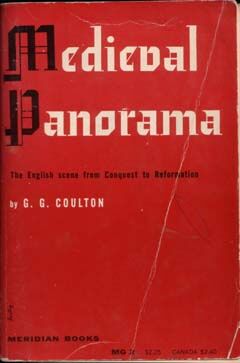
Medieval Panorama (1955)G. G. Coulton |
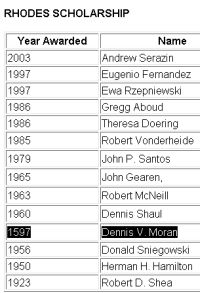
From Notre Dame's list of Rhodes Scholars. (Scholarly note: 1597 is just a tad early for Moran; 1957 would seem to be a slightly more likely date, Notre Dame webmaster.) |
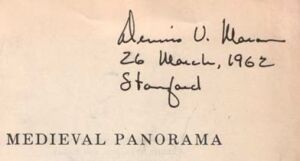
I was at a thrift store and came across a huge trove of great books, which I began grabbing until this one fell open & I saw the name inside: Dennis V. Moran.
Dr. Moran had been one of my favorite college professors. He had also recently died. Unlike most of my professors, Moran had the kind of intelligence that makes one disdainful of bureaucratic nonsense and the P.C. foolishness that was at that time already taking over universities. He was also witty, sarcastic, and impatient with stupidity. The former alienated him from the university bureaucracy; the latter from many of the students, who typically displayed varying types of fear in the face of his imposing demeanor. One day Dr. Moran gave us one of his dreaded tests: three huge essay questions and ten or so identification items. The final identification item on the test was Narom Sinned. It sounded so familiar. I knew that in this context *Sinned* couldn't be a verb. I thought immediately, of course, of Naram-Sin of Akkad and his famous victory stele, and even though I couldn't remember Moran having mentioned it, or what it would have to do with English Lit, I'd finished the rest of the test and there was plenty of class time remaining, so I made a try at BSing it and wrote whatever I could think up to say on that topic, just to see what Moran would do. At the next class meeting he passed back the blue books and instead of chewing me out when he gave me mine, he smirked and said, "Nice try." It turned out that the test had come out a few odd points short of totaling one hundred, so Moran had thrown in a nonsense question and awarded every student those points no matter what the answer. I should have recognized instantly that Narom Sinned was merely denniS moraN backwards. After that, Moran seemed to accord me a little more tolerance than was his custom. Another thing that helped was my presence as a sophomore undergrad in his graduate-level Anglo-Saxon language class. The others were all grad students who had to be there and didn't want to be. I wasn't in college to get a degree; I was just taking classes to learn stuff I wanted to know (which I was permitted to do only until the university computer figured it out and forced me to graduate). Back in the undergrad classes, if I said anything halfway clever, Moran would beamingly announce, "I gave this man all his command of the Anglo-Saxon language," always following up with a glance over his glasses and the qualifying phrase, "such ... as it is." Though a Catholic of some sort, Moran used to refer to himself as a Lethargic Vitalist. He had been a Rhodes Scholar, and his lectures often included echoes of his time at Oxford. Whenever India was mentioned in whatever he was reading aloud, he would look away wistfully and say, in his best pukka British accent, "Pit-ehhhh-y we lost INNNNNN-jah..." and then continue on as though this was just what one properly did whenever one encountered the word India. As a longtime accumulator (not collector) of books, finding Moran's books haphazardly strewn about in a thrift store was an eye-opening reminder of what it all comes to: your library—thousands of books, linked by threads nearly as personal as DNA and incomprehensible to anyone else—broken up and carried off in every direction. "Dust to dust" applies to paper as well as flesh. I didn't need most of his books that were sitting there in that thrift store, but I couldn't allow Dennis V. Moran's books to be pawed over by bargain hunters, so I bought them all. Some I gave away to others who knew him, others to people who would just appreciate them, and the one you see here I still have. (Like Kit from Badlands, however, I quickly realized that I should've kept a smaller one.) |
 |
 |